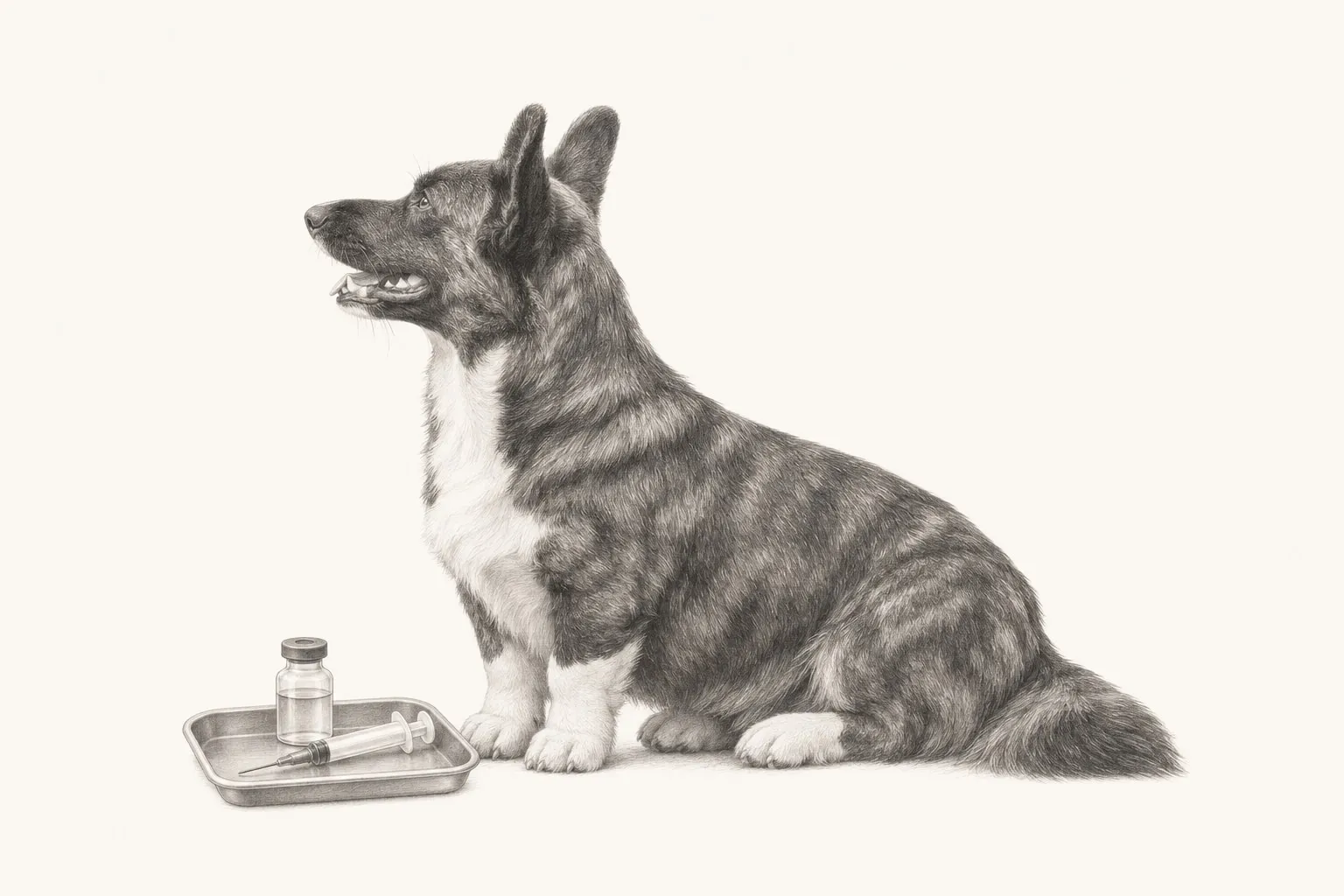
Which vaccinations your dog needs
On this page, I will list which vaccinations are needed and how often.
I will divide this content into two sections, for puppies (under a year) and adult dogs. Let’s start with the simple one: adult dogs.
Before describing which vaccines a dog should receive and how often, I will explain what each of them means.
Meshushe (a six-component vaccine) — this vaccine contains protection against 6 infectious diseases (including parvovirus) that pose a danger to both young and adult animals.
Rabies — this is a mandatory vaccination for every dog. It is a vaccine against a disease that is also contagious to humans.
Park worm injection (spirocercosis — Spirocerca lupi) — in fact, this is not so much a vaccine as preventive treatment against a deadly pathogen that enters a dog’s body when they eat infected dung beetles, which can lead to death.
Deworming — given by injection or tablets. Dogs with worms are given an injection or tablet, and then the procedure is repeated. This treatment is recommended for all dogs.
Vaccinations for adult dogs (one year and older)
- Rabies (also linked to the dog tax in Israel) — once a year.
- Meshushe — once a year.
- Deworming — once every six months.
- Park worm — every 3 months.
- Bravecto (for ticks and fleas) — every 3 months.
Vaccinations for puppies
- Deworming (usually at 4–6 weeks), repeated after 10 days, and then every six months.
- Meshushe — at 6 weeks, 9 weeks and the last one at 12 weeks. We vaccinate 3 times because it is unclear when the mother’s antibodies will stop working. After that, repeat one vaccination a year for an adult dog.
- Rabies — once a year. By law, a puppy must be vaccinated from 3 months of age.
- Park worm — every 3 months from the time the puppy starts going for walks.
- Tick and flea treatment — at the owner’s discretion. I recommend giving a Bravecto tablet every 3 months. In the winter months, I may skip it (again, at my own risk).